Things ‘The Book of Mormon’ Didn’t Tell You
The Mormon faith is an offshoot of Christianity and it is thriving and growing more rapidly than any other. But it did not always enjoy acceptance from the Christian community.
Founded by Joseph Smith, the modern and quintessentially American religion sprang from an historic era of religious fervor and meandered its way home to Utah. Mormons, or Latter-day Saints (LDS), as they prefer, have matured as an evangelistic faith. They knock on doors spreading the word, but for some reason, we know relatively little of them. We are more familiar with “The Book of Mormon” South Park musical than we are about how followers of the faith actually live. So here’s the rest of the story.
The Book
The “Book of Mormon” reads like a prequel to the New Testament. Rooted firmly in American soil, it tells a never-before-heard story about Jesus Christ. It also offers reboot versions of such biblical accounts as the Garden of Eden, and the Gospel of John.
According to the “Book of Mormon,” Jesus fled Israel and took refuge amongst Native Americans in the American wilderness about 600 years before biblical accounts of Christ. This telling, exclusive to the “Book of Mormon” asserts Christ established another promised land on the American frontier. It claims to be historically accurate, but modern archaeology disagrees.
The Book Offers a Plan of Salvation
“The Book of Mormon” differs from the Bible with its treatment of personal salvation. The Bible does not offer guides to salvation, but the newer Book does. The idea of salvation is mentioned at least 30 times throughout the book. It specifically refers to a “plan of salvation,” a “plan of happiness” and a “plan of redemption.” The path to salvation begins by allowing people to follow the gospel of Christ and concludes with entering heaven. The final judgement is not terrifying but instead positive growth toward joy, freedom, and responsibility.
A Quintessential American Religion
For Americans, the religious foundation of Mormonism on the North American continent was appealing. The stories of Christ by the prophet Joseph by visits of angels sent by God and epiphanies he had inspired religious fervor. In the early 19th century, a spiritual revival was brewing, called by historians the restorationist movement, Joseph Smiths’ visions and prophecy sold like hotcakes. Christians flocked to this new sect much like American evangelicals of the 21st century moved in droves toward the Christian mega church establishment.
Joseph Smith’s Superstar Appeal
Mormonism was tightly organized with an appealing backstory. But it also came with a galvanizing figure. Smith was known as a prodigy and a prophet. Handsome with bright blue eyes, he had magnetism, he had charisma, and he possessed the ambition to lead. He preached an intriguing new scripture, a brand-new testament of Jesus Christ. He rounded up converts with rock star-grade fervor. According to Smith, according to himself, God and Jesus told him that none of the Christian sects were worth joining, so he founded his own.
The City of Nauvoo
He established a booming town that became filled with Mormons. In 1840, Joseph Smith purchased land in Illinois called Commerce. He renamed it Nauvoo, a word from Isaiah 52:7: “How beautiful upon the mountains.” Providing a place for Mormons who were continually persecuted, the city grew to be the largest population outside of Chicago. Since Smith owned the land, he also oversaw the city, the militia, and the courts.
Joseph Smith’s Fan Club
We know that Smith began having visions of God and Jesus and pillars of light at age 14. In those days, there were a lot of people who claimed to be prophets, but Smith captured imaginations. His vision of an angel named Morani in 1823 prophesied a set of gold plates containing the angel’s teachings. These words, revealed and dictated by Smith, would populate the pages of the “Book of Mormon.”
Not all folks ascribed, and many loathed him, starting with the father of his first wife, Emma Hale. He called him “insolent.”
Why People Hated Smith
Smith was adored by his followers, but he was despised by many. His doctrine preached Christian scripture that was not in the scripture. To many Christians of the era, Smith’s new sect was heretical.
Just as offensive, Smith willfully married multiple wives, refusing to adhere to societal norms, even after a movement led by his detractors succeeded in making polygamy illegal in the U.S. by 1862. Smith reportedly took in as many as 40 wives. Mormons were forced from one place to another to avoid persecution, like the David Koresh sect, which was finally detonated in Texas.
Did He Really Have 40 Wives?
Yes, The Church of Jesus Christ of Latter-day Saints recently published information about their founder’s plurality of wives. Records do not show all the wives he eternally sealed with, code for intimacy in marriage, but he did have at least 40 seals under his belt. Some were also married to friends of his.
The youngest, Helen Mar Kimball, was 14 when they married and his oldest was Fanny Young, 56 at the time of his death. According to the prophet, an angel of God came to him several times and commanded him to go ahead with polygamy, or “plurality” as he preferred to call it.
Did Bingham Young Have More Wives than Smith?
Yes. Bingham Young has about 55 verifiable wives on record. He married single women and widows. Strangest of all, he was sealed with two different mother-in-laws. He took to polygamy, but not at first. Young swore he was a happy monogamist in his first marriage to Mary Ann Angell. Changing his ways was Joseph Smith who instructed Young to partake in plural marriages. His polygamist lifestyle peaked in 1846. In that year he married 20 wives. On the spousal end, it wasn’t all fun and games. Wife Zina Huntington sobbed bitterly upon moving into a home with multiple wives.
The 1838 Mormon War
The war, known also as the Missouri Mormon War, created the need for Mormon relocation in Nauvoo. Tensions and anti-Mormon violence led to Missouri governor Lilburn Boggs ordering Mormons to leave Missouri or be killed. Most of Smith’s followers escaped, joining an exodus of 10,000 who made it safely to Nauvoo. It’s hard to say exactly why backlash against Smith’s disciples was so virulent but naming Missouri the holy land did not help. He said the town of Independence in Missouri would be the Mormon City of Zion, land for his followers to inhabit.
The First Detractors of ‘The Book’
Smith rose to prominence in western New York where he grew up as a farmer. This is where he acquired his first flock of followers. But by 1831, his LDS converts were already feeling the burn of the prophet’s critics. The ridicule of anti-Mormon sentiment marked the onset of the Mormon church’s slow crawl westward, riddled of course with conflicts like the war in Missouri. Ultimately destined for Salt Lake City, the modern church has proliferated abundantly ever since.
Smith was Tarred and Feathered in Kirtland
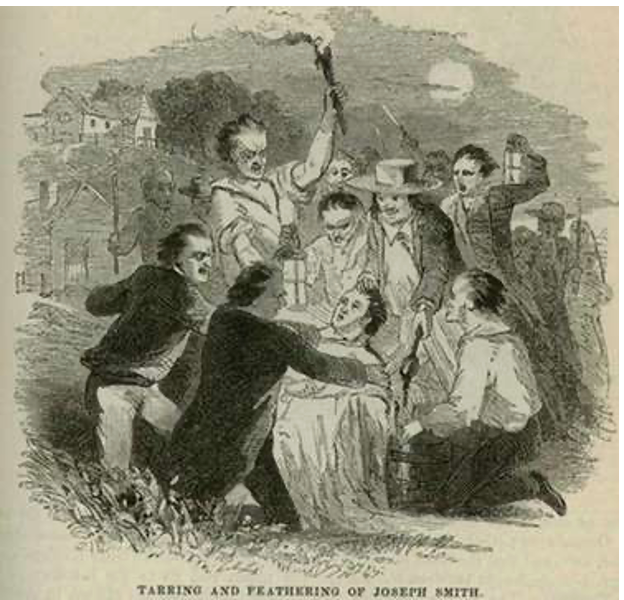
Anti-Mormon tensions were high in Kirtland, Ohio. The LDS faced hostile persecution, this time it was Smith. On March 24, 1832, Smith and at least one of his church counselors were at Smith’s home looking after his child who was ill with measles. It was late at night and an angry mob kicked down his front door and snatched the two men. Smith was dragged outside, striped, covered with tar, and coated with a layer of feathers. At the time, he was in the process of erecting a temple on the Kirtland settlement.
Building his First Temple
Upon Fleeing New York, Smith and his people landed in Kirtland, Ohio. For six years they flourished there. A year after arriving, Smith had a revelation from God to build a temple.
That was just the start. Smith claimed to receive 65 revelations during construction. He managed to oversee the project with a small group of impoverished followers. Church members donated labor and materials like glass and pottery used for making stucco. Soaring to 110 feet, it was reverently dedicated in 1836.
Why the City of Zion Temple was Never Built
During the temple construction days of the Kirtland church, plans to build a sprawling compound of temples in the city of Zion were underway. Smith received a revelation in 1831 for building an “everlasting inheritance.” In 1833 the master plan was underway. It intended Jadson County, Missouri to host 24 temples and accommodate 20,000 people. Why didn’t it happen? Once again, Mormons were chased out. Missouri citizens expelled the LDS from the city.
Running for President Sealed his Fate
Already considered a lighting rod for his beliefs, running for president brought Smith even more negative attention. He exacerbated this situation attempting to shut down his dissenters. A group of disgruntled former Latter-day Saints published the “Nauvoo Expositor,” a newspaper criticizing his leadership, especially his adherence to polygamy.
Smith fired back. As leader of Nauvoo, he ordered the destruction of the press and he sent out the militia to enforce it. He was charged with treason and conspiracy, along with his brother Hyrum.
He Died a Martyr
No longer welcom in the Illinois city he founded, Smith was arrested for treason and conspiracy. He and his brother were jailed in neighboring Carthage in February 1844. At first, he attempted to flee. After consideration, however, Smith decided to accept his fate.
On June 27, 1844, a 200-strong anti-Mormon militia swarmed the Carthage jail cell and assassinated Smith. Smith fired all the pullets of the pistol he had smuggled in, but the mob had more. His brother Hyrum was shot in the face, the first to die. Smith’s bullet-ridden body fell from the second story window during his attempted escape.
The Making of a Martyr
Upon learning his fate and returning to Nauvoo to face charges, he said, “I am going like a lamb to the slaughter.” He also imparted to his followers, “I shall die innocent and it shall yet be said of me--he was murdered in cold blood.” This is the part the Mormons believe. Modern LDSs are taught to love Joseph Smith, to the point that most LDS’ do not know Smith used military power to destroy the presses of the “Nauvoo Exposition” publication.
Polygamy is Legal
Just a year before his bloody downfall, Smith declared polygamy legal in the eyes of God. In a celestial power grab, known officially as the doctrine of “celestial marriage,” Smith said certain Mormon men could retain plural marriages.
It wasn’t his law; it was authorized by a revelation directly from God. In 1843, according to Smith, God commanded humans to live in plural marriages and strive to reach the highest realms of heaven.
King of the Church of Jesus Christ of Latter-day Saints
It was shortly after the temple was built when Smith began organizing his church into something more like a Hebraic model of power. The hierarchical setup designated deacons, elders, bishops, and priests. And at the top, naturally, was Smith, “First President.” He failed to win the U.S. presidential election so he would preside here. With this new power, Smith won sole authority over receiving revelations from God and this is how polygamous marriages were sealed.
Some of the Stranger Things Mormon
To nonbelievers, the idea of God appearing to a polygamist to tell him polygamy is ordained by heaven, is, let’s be honest, a bit strange. There are other strange beliefs we can point to. The LDS Church accepts the story that Adam and Eve lived in Daviess County, Missouri after being expelled from the Garden of Eden. We always wondered where they went, so The Book of Mormon explains it. They also believe John the Baptist, one of the most revered apostles of Christendom, appeared to Smith to tell him to preach the “true” gospel. Smith was transcribing the “Book of Mormon” at the time.
Exaltation is New Christianity
Exaltation, or what is called the plurality of gods, allows Mormons to become gods and live in the presence of God and Jesus Christ, along with the Earthly family. This sounds like a good deal. Dying takes away none of your Earthly spoils, if you’re a good Mormon who achieved this privilege. Smith even went as far as to include Earthly pleasures to the realm of heaven in exaltation. The Church says that even after death, exalted Mormons will continue enjoying intimacy in marriage, introducing a realm of heaven never before imagined. Signing up with Smith’s doctrine offers a lot of perks for believers.
Statehood in Utah
In 1890 the supreme court ruled to essentially dissolve the Mormon church due to its insistence to practice polygamy. At that point, the church caved, upon threat of seizure of church property by the U.S. government. A document called “The Manifesto,” released by LDS president Wilford Woodruff officially renounced polygamy. Achieving statehood was worth it but the rejection of polygamy was coerced. Added to the fact that Smith had written into the religion the go-ahead for plural wives, many Mormons refused to recognize the federal law.
A Tolerant People
During Joseph Smith’s lifetime, the Civil War was raging in the south so we know he spoke out against slavery. Under his leadership, scripture taught against slavery. Since the central narrative to the “Book of Mormon” is about an Israelite family arriving in New York and finding the Lamanites, a population and a dark-skinned, early Native Americans, there has been teachings of respect for natives built in. The Mormon religion shows respect, or at least lip service to Native Americans.
‘A White and Delightsome People’
On the other hand, the “Book of Mormon” contains remnants of white supremacy. And it wasn’t until the 1970s that those tendencies were addressed. Why? Because a passage in the “Book of Mormons” says LDS “shall be a white and delightsome people.” For the record, it was Brigham Young who ruled in 1852 that black men could not hold priesthood, based on the passage. Young believed in slavery and owned slaves. He preached moderation in treatment of slaves out in the fields but warned against elevating them to equality of whites.
And What About That Other Book?
There are those of us who have learned everything we know about Mormonism seeing “The Book of Mormon,” the catchy-tuned and fun-filled musical by South Park creators Trey Parker and Matt Stone. Expecting biting irreverence all the way through, it comes as a surprise at intermission that it is almost a celebration of the LDS Church. When the curtain goes up after the intermission, however, it is a different story. The floodgates open. The initially expected onslaught of crude, lewd, inane and violently improper humor unleash for about an hour. Upon leaving the theater, one can only wonder how deeply offended an LDS in the audience must have felt.
Missionary in England Talks about the “Book of Mormon” Musical
A missionary in England named Richard talked about opening night at the Prince of Wales Theatre in London. He said that he staked-out at the venue ready to spread the word. He looked at the musical as the church does. He takes it for what it is, as for-profit entertainment, but also as an opportunity to convert the willing. Richard had not viewed the production in full, but he had seen certain parts. He said some of those parts were very funny and that, overall, the musical was meant for people to have a good time.
‘South Park’ Creators Might Have Gone Over the Line
Richard’s very upbeat demeanor turned somber as he talked about specific content of the musical. Trey and Matt’s signature irreverence is impossible to ignore. Speaking to “Lifey” via a video interview, Richard talked about the way the church teachings had been taken out of context in a bad way. Even though he felt “The Book of Mormon,” the musical, was not meant to bash his religion, but for fun instead, he still could not help feeling hurt. Sharing how he really felt he said, “Some very sacred things are made to be playful: and that' s a little difficult. Because, seeing those things “in a very nonsacred context is harder to take as a believer in those things.”
Trey Parker: ‘I think Jesus wanted this to happen’
The dynamic duo of dissing everyone joined “60 Minutes” on CBS to talk about the massive success of the musical. The “South Park” creators wrote the lyrics and script with help from Bobby Lopez, first known for scoring the Oscar-winning “Frozen” soundtrack. The collaboration created the worldwide smash. When the boys are asked about whether “The Book of Mormon” is anti-Mormon they demure. Trey Parker says that no one wants to see two hours of Mormon bashing. “It’s not a 2-hour-hourlong Mormon bashing, it really isn’t.” Matt Stone breaks in with a quip of truth, “It’s about an hour bashing.”
All About Mormons
South Park enthusiasts will know “The Book of Mormon” sprouted from a Season 7 episode called “All About Mormons.” It tells the story of Joseph Smith transcribing “The Book of Mormon,” succinctly, to music, and, of course, it satirizes the prophet. How? It is not ambiguous, the show laugh-tracks at him when he is called a prophet, “Dum, dum, dum, dum, dum,” goes the chorus. And again, punctuating his claim that he translated the gold books by holding “seer stones” next to his eyes. When a woman in the 19th century town calls Smith a fake, the chorus is, “Smart, smart, smart, smart, smart.”
The South Park Guys Grew Up Knowing Mormons
The pair dreamed of doing a big musical for a long time. Making it about Mormons was a no-brainer. It all started with their background in Colorado and making the South Park TV episode. The show surfaced in 2003 and by 2011 they had their Broadway musical. Despite its savage mockery, they knew there would be no Mormon backlash. Trey explains, “We grew up with a lot of Mormon friends and my first serious girlfriend was Mormon, so we knew a lot of Mormons.” He knew the Mormon MO well. “They’re going to be cool about it.” He was right.
Post a comment